
Author: Mgr. Martin Jelínek
Expertise: nutrition, education in nutrition
Last expert review: August 25, 2026
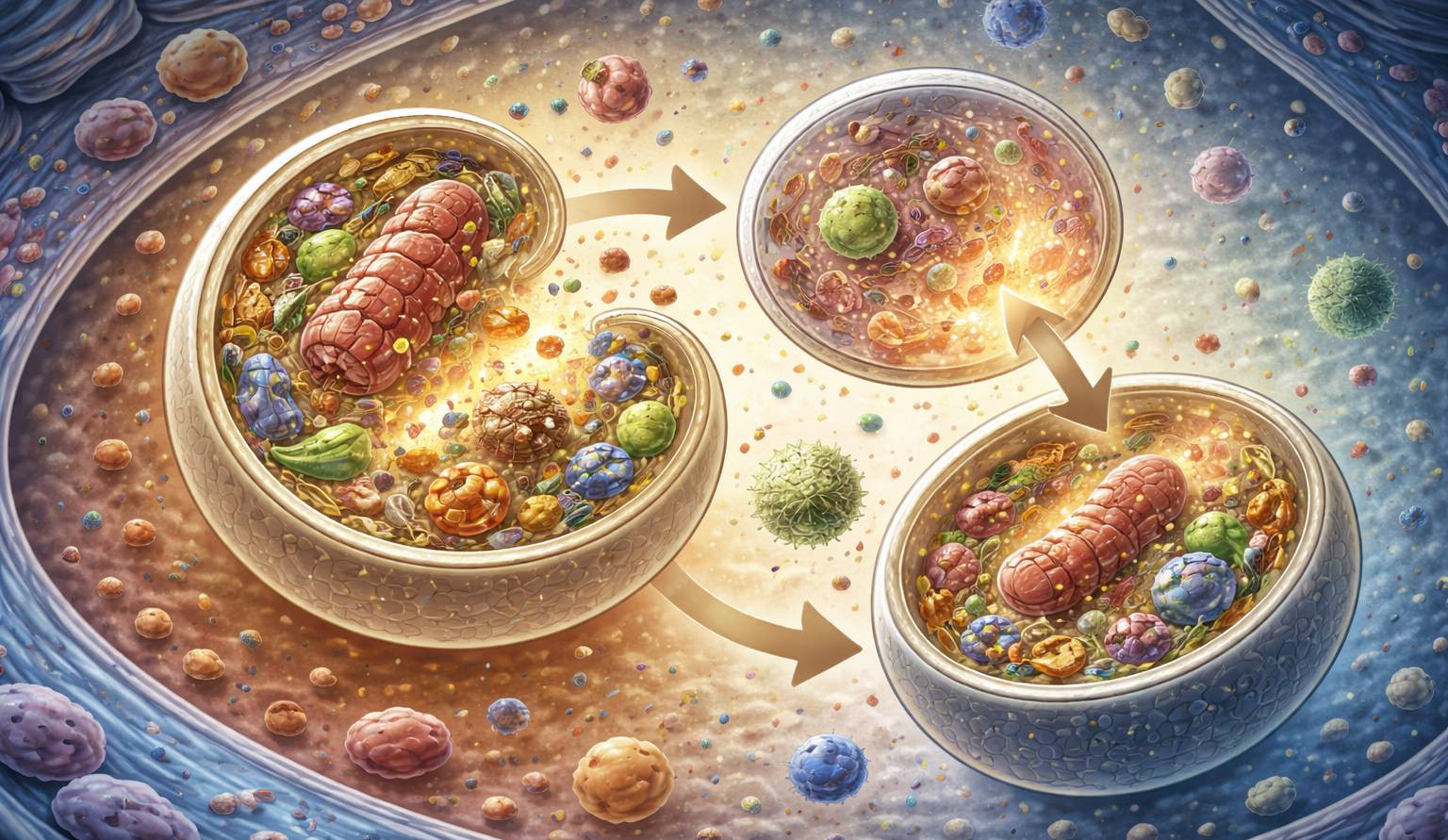
Autophagy is one of the fundamental mechanisms through which the cell continuously maintains its internal environment in order. The name comes from the Greek words autos (self) and phagein (to eat) and can be loosely translated as "self-digestion." In this process, the cell recognizes unnecessary, damaged, or nonfunctional components, breaks them down, and subsequently reuses their parts. It is not a destructive mechanism but an important regulatory process that allows cells to:
Autophagy occurs in the organism continually and represents one of the fundamental mechanisms of cellular maintenance. Through it, damaged proteins, nonfunctional mitochondria, and other cellular structures that would otherwise disrupt its proper function are removed from the cell. Autophagy thus plays a crucial role in protecting cells from stress, inflammation, and degenerative changes. [1]
In 2016, a Nobel Prize in Physiology or Medicine was awarded for elucidating the mechanisms of autophagy, which clearly demonstrated the crucial role autophagy plays in understanding cellular processes and their impact on health.
Autophagy proceeds in several consecutive steps:
Autophagy operates according to the conditions of the cell. When it has ample energy and nutrients, there is no need to "clean up" on a larger scale. However, when it experiences an energy deficit or is subjected to stress, autophagy is activated and helps the cell survive. [2]
As age increases, the cellular cleaning system begins to function less efficiently. Autophagy gradually weakens, leading to the accumulation of damaged proteins and nonfunctional cellular components in the cells. These then interfere with normal functioning and slow down their renewal. Tissues regenerate less effectively, cells become more vulnerable, and the organism gradually loses part of its vitality. The reduction in cellular maintenance is considered one of the important mechanisms of aging. [3]
When autophagy does not work adequately, the risk of chronic diseases, which typically appear at an older age, also increases. The organism becomes less resilient to stress, has a harder time coping with stress, and recovery from damage takes longer. It is therefore not surprising that supporting autophagy is among the main areas of current research focused on aging and maintaining health over the long term.
Much of the understanding of the relationship between autophagy and life extension comes from cellular and animal models. Therefore, it is currently not possible to claim that targeted enhancement of autophagy in itself slows aging or extends life in humans. [9] [10]
Autophagy is one of the key mechanisms by which cells maintain internal balance and good condition. It acts as a protective system that helps remove damaged and unnecessary proteins, mitigate harmful effects of oxidative stress, and keep inflammatory processes under control. It also plays a significant role in the immune system, where it participates in the destruction of harmful microorganisms and ensures the proper functioning of immune cells.
Thanks to autophagy, cells can better adapt to stress and demanding situations. This internal maintenance program allows them to function reliably even under challenging conditions and maintain their performance in the long run.
If autophagy does not function optimally, the risk of a wide range of lifestyle diseases increases. In metabolic disorders such as obesity or type 2 diabetes, its weakening may contribute to the development of insulin resistance and long-term, low-level inflammation in the body. [4]
However, in metabolic diseases, it is not yet possible to simply say that autophagy is always "insufficient." Results of human studies differ according to the tissue, stage of disease, and method of measurement, and it is not always clear whether the change in autophagy precedes the disease or is its consequence. [4]
The crucial role of autophagy is also evident in the nervous system. Insufficient autophagic activity leads to the accumulation of pathological proteins in nerve cells, typical for neurodegenerative diseases. [5] Similarly, autophagy is important for the health of the heart and blood vessels – it influences the condition of the vascular wall and the function of the heart muscle, thus contributing to the protection of the cardiovascular system. [6]
Autophagy is a very dynamic process. Simply finding a greater number of autophagosomes, for example, does not necessarily mean that the cell is actually breaking down more material – it could also be a situation where another phase of the process has slowed down. Therefore, in professional research, the so-called autophagic flux is monitored, which is the course of the whole process from the creation of the autophagosome to the breakdown of its content.
The difficulty in measuring autophagic flux is one reason why results from cellular or animal experiments cannot simply be applied to humans, and why it is not possible to determine a universal fasting duration after which "autophagy" will start in each individual. [9]
Autophagy is not a fixed process; its activity is greatly influenced by how we live. One of the strongest triggers is a period when the body does not have a constant energy supply. During fasting or reduced calorie intake, autophagy is naturally activated, and cells begin to recycle their own resources more intensively. Various forms of fasting, which consciously limit food intake for a certain period, are based on this principle. Periods without food create metabolic conditions in which the body switches to a more economical mode, potentially activating autophagic processes.
Movement also plays a significant role. Regular physical activity supports autophagy in muscles, liver, and brain, helping keep cells in good condition. This improves not only metabolism but also the overall resilience of the organism.
Conversely, long-term stress, lack of sleep, and a sedentary lifestyle can suppress autophagy and gradually disrupt the natural regenerative capabilities of the body.
What we eat – and how often we eat – has a surprisingly strong impact on autophagy. If the body receives energy constantly and in excess, especially in the form of sweets, products made from white flour, or sugary drinks, insulin levels remain elevated over the long term. This is a clear signal to the cells that they have enough fuel, and internal cleaning is therefore sidelined. Autophagy is suppressed in such conditions.
As soon as the energy supply is restricted for a certain period – for instance during longer intervals between meals or with lower caloric intake – hormonal and cellular signals begin to change. Insulin levels decrease, and cells gradually shift to a more economical mode. Under these circumstances, autophagic processes can be activated, breaking down damaged cellular components and reusing them. This mechanism helps cells better cope with energy deficits and other forms of stress.
These mechanisms are well described biologically, but their intensity and timing vary between different tissues. Therefore, a decrease in insulin cannot determine the specific moment when autophagy begins in a person. [9] [10]
What is important is not only the quantity but also the quality of the diet. A diet based on natural, minimally processed foods creates a much more favorable environment for proper cell function than a diet rich in industrially processed products and added sugar.
Additionally, certain substances naturally present in foods, such as polyphenols, found in fruits, vegetables, tea, coffee, cocoa, or olive oil, can play an interesting role. These substances are being studied for their protective effects on cells and their ability to support natural regenerative processes. While they do not "trigger" autophagy by themselves, they can contribute to long-term cell protection and maintaining their good condition. [7]
No. Autophagy is a regulatory process, and its relevance depends on the specific tissue, health condition, and situation. Therefore, the goal is not its permanent maximum activation, but a well-functioning regulation. [9]
This reality is well exemplified in cancer diseases. Autophagy may help limit cell damage in early stages, while some existing tumors can exploit it to survive under nutrient scarcity, hypoxia, or other stresses. Hence, the simple assertion that "higher autophagy protects against cancer" is not correct. [11]
Autophagy is not a miraculous switch for diseases nor a standalone treatment method. However, it is an extremely important natural mechanism through which the organism continuously adjusts, repairs, and maintains cellular environment balance.
It cannot be automatically attributed that the health benefits of fasting, exercise, or calorie restriction are due solely to autophagy. These interventions simultaneously affect a variety of other metabolic, hormonal, and cellular mechanisms. [9] [10]
The key is not a one-off intervention or an attempt to "trigger autophagy," but rather a long-term balance. A balanced energy intake, regular exercise, sufficient sleep, space for regeneration, and psychological well-being create an environment in which natural mechanisms of cellular maintenance can function effectively.
Similarly, there is no need to automatically prolong fasting just to allegedly make autophagy "stronger." The organism's response is individual, and autophagy is only one of many components of the response to an energy deficit.
Sources:
[1] Annual Reviews
[2] PubMed Central
[3] PubMed Central
[4] PubMed Central
[5] PubMed Central
[6] PubMed Central
[7] PubMed Central
[8] Nobel Prize
[9] PubMed
[10] PubMed
[11] Nature

Mgr. Martin Jelínek
Founder of NutriCourses, lecturer and author of the educational system in the field of nutrition. He has been systematically engaged in nutrition education since 1999. He is the author of the educational application ZOF and professional publications focused on nutrition and a healthy lifestyle.